
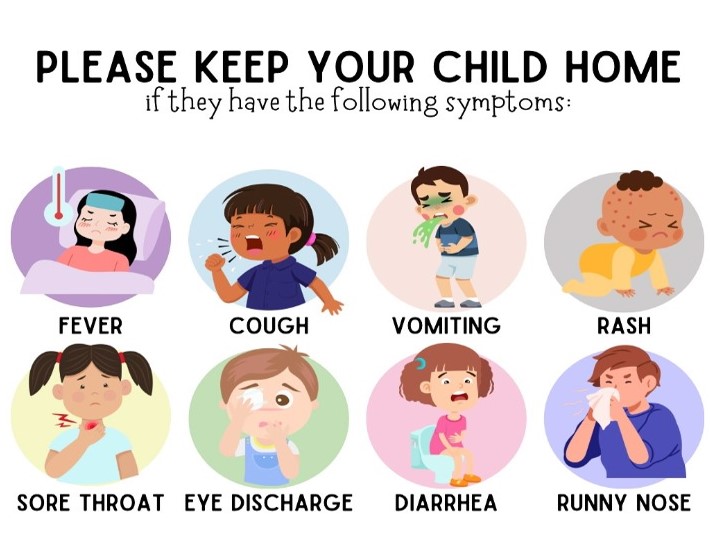
 Sometimes it can be tempting to send your child to school when they complain of feeling sick. Please be thoughtful of others and keep them home. Illness spreads fast in the classroom. It is strongly suggested that parents NOT send your child to school if he/she has:
· Common cold – irritated throat, watery discharge from the nose or eyes, sneezing, chills and/or general body aches. Keep your child home if symptoms are serious enough to interfere with your child’s ability to learn. Seek care from the doctor if symptoms persist beyond 7-10 days, fever or cough producing phlegm develops, or nasal discharge becomes yellow or green.
· Cough – Cough that interferes with the child’s ability to fully participate in classroom activities. Seek care from the doctor if the cough lasts beyond 7-10 days, or if coughing phlegm.
· Fever – If the child’s temperature is 100.0 degrees or higher, the child should remain at home until they are without a fever for a full 24 hours without the use of fever reducing medication. Remember that a fever is a symptom indicating the presence of an illness.
· Flu – symptoms include abrupt onset of fever, chills, headache and sore muscles. Runny nose, sore throat and cough are common. Your child should remain at home until the symptoms are gone and they are without a fever for a full 24 hours.
· Vomiting or Diarrhea – Your child should remain at home until without vomiting, diarrhea or fever for a full 24 hours. No suppressive medications should be used within those 24 hours.
· Pain – If your child complains or their behavior indicates they are having persistent pain, they should see a doctor before being sent to school.
· Pinkeye – The white of the eye appears red, swollen, burns, itches or has pus-like drainage. This requires treatment from a doctor. Your child may return to school after taking antibiotic treatment for 24 hours.
· Strep Throat – The throat appears severely red, swollen or has whitish pus spots. Other symptoms include, throat soreness, fever, swollen glands of the neck, nausea or vomiting. This requires treatment from a doctor. Your child may return to school after taking antibiotic treatment for 24 hours and no longer is vomiting or has fever.
· Skin Rashes – If your child has a rash of unknown origin, they must be seen by a doctor before coming into school.
*** If your child becomes ill at school and the teacher or school nurse feel the child is too sick to benefit from school or is contagious to other children, you will be called to pick them up from school, and possibly take to the doctor for further medical assessment or intervention.
It is essential that the school have a phone number where you can be contacted during the day and an emergency number in the event you cannot be reached. Please be sure that arrangements can be made to transport your child home from school and that childcare is available in case of illness. If your daytime or emergency phone number changes during the year, please notify us.